
I came across these fish while swimming out from our apartment complex to cull some Lionfish. At first I thought they were scorpion fish sitting on the hardpan, I almost hadn’t spotted them, but then, somewhat spooked by my presence, they opened out their fans and swam away. One of the most impressive fish I have seen, showing the great variety of life underwater, Dactylopterus volitans, the Flying Gurnard, I will be looking out for them again! Read more…
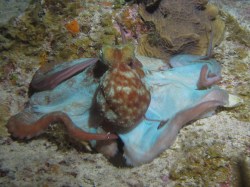
Always a pleasure to see on a night dive, this Octopus entertained us by pulling some shapes and changing colour to match the background – Turtle Reef, Grand Cayman. Read more…
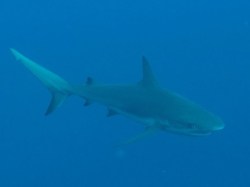
A slight cheat this week with an old picture of a reef shark taken in Grand Cayman’s East End. Please forgive me because I have been lain low with a bad back and separated from my laptop with my images while travelling. Don’t get me started on bad backs and the ineffective remedies I have tried to overcome it on this trip! Read more…
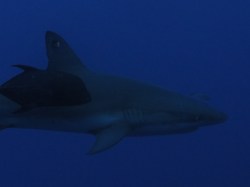
It’s always amazing to see Sharks in their natural habitat, and sickening to think of the Shark fin trade. Whilst many people have a fear of seeing sharks, most divers count it as one of their most special encounters. Since I got a first glimpse of them retreating in the deep in Africa (see Diving Zanzibar – my first sharks!) I have always hoped to bump into some of the “men in grey suits” on each dive in Cayman and have been lucky enough to swim with Nurse Sharks and Reef Sharks. Sadly no Hammerhead yet! Bull and Tiger sharks, I’m not so sure I’d be thrilled to see, but what a tale to tell afterwards!
This reef shark was in Little Cayman and was accompanied by a large Jack of some sort (based on the shape, but not the colour).


During a rainy day in Cayman (we get them occasionally, and the outdoor lifestyle leaves little to do but admin or watching dvds) I was experimenting with Adobe Lightroom and some of my underwater shots. It’s more fiddly than Vivid-Pix (see my post on Vivid-Pix on dive photos) but you can tailor it a little better for individual photos. Vivid-Pix is good for producing a number of photos from a dive, but I think for those one off shots, I will take the time to use Adobe in future. If anyone has any tips for how to best process their images, do let me know!


Epinephelus striatus, the Nassau Grouper, is one of several types of Grouper often seen on dives in the Cayman Islands. They are a predator fish that are not afraid of divers and have learned to feed from Lionfish killed by divers. As such, they will often join the Snappers getting in the way of a clean kill shot and waiting for a free feed. They have large, expressive faces and make good company on a dive.
Sadly they appear on the food chain in Cayman, “fresh catch of the day – Grouper”. I’m told it tastes good, but do e a favour, order something farmed from the menu and save them for viewing on the dive.


The Cayman Islands are known as a collection of small islands in the British West Indies. They are creatively named Grand Cayman, Little Cayman and Cayman Brac (Gaelic for bluff). There is also a little known Owen Island, which makes Little Cayman look grand! Read more…

I had no idea what this intriguing flat fish was, half buried in the sand, on my way back from a dive at Turtle Reef Macabuca. So, I was excited to identify it in my Reef Fish book as the Peacock Flounder (apparently common, but pretty interesting for a boy from Dudley) the Bothus Lunatus, it can apparently change its colour to match the bottom, including darkening or paling its shade. The more fish I read into for the Fish ID Friday, the more I realise this is a common feature in fish, a feature featured mostly in Sci-fi creations but quite common when I’m on a dive!
I would like to have seen it with the peacock fin projected, but a great spot all the same! Have you spotted anything dwelling in the sand on one of your dives?

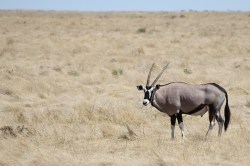
I was thrilled to finally see an Oryx, such an intriguing animal, like a cross between a zebra, a unicorn and an antelope. We were lucky enough to track one down in the Etosha National Park on the Acacia Africa Ultimate Overlander we were lucky enough to go on in 2011. Read more…

One of my favourite places in the world is Boulder’s Beach, a short drive from Cape Town on the Cape Peninsula. A sandy cove, dotted with large granite boulders, it is an incredibly scenic spot but also home to a colony of African Penguins who settled there in 1982. Barely a foot in height, these little fellows are full of character and playful. Read more…
 Tubbyman Tales